Showing posts with label Theology. Show all posts
Showing posts with label Theology. Show all posts
Wednesday, March 26, 2008
Brush up on your Old Testament history
I've recently finished listening to a series of 36 lectures on Old Testament history which are available free for download from the Covenant Theological Seminary website. The are given by Dr. V. Philips Long, former professor at Covenant Theological Seminary and I highly recommend them. I found them very easy to listen to and they really helped me put many of the events of the Old Testament into the correct biblical context. Also, the lectures have a very pastoral style and are full of challenging application. Definitely worth a listen! You could also check out the other material available for download from the seminary.
Wednesday, May 23, 2007
Redeeming the Time
 Just a quick recommendation of a useful resource. Few of us may get the opportunity to study at bible college or seminary, but every Christian can benefit from the sort of teaching provided there. One way we can achieve this is using the otherwise "dead time" while we drive to work, make dinner or clean the house. An excellent resource to help us do this is the Biblical Training website which has a range of talks available for download from lay to seminary level.
I'm working my way through the New Testament Survey which is taught by Dr Bill Mounce and I can highly recommend it.
Monday, November 13, 2006
Wicked?
 Wicked, by Gregory Maguire, is one of the top 20 books in Waterstones bookstore just now. My husband made reference to it in his sermon last night, mentioning how society is redefining - indeed almost erasing - the concept of wickedness (or in biblical terms: 'sin.')
According to Amazon's synopsis, Wicked vividly captures this trend: "An astonishingly rich re-creation of the land of Oz, this book retells the story of Elphaba, the Wicked Witch of the West, who wasn't so wicked after all. Taking readers past the yellow brick road and into a phantasmagoric world rich with imagination and allegory, Gregory Maguire just might change the reputation of one of the most sinister characters in literature."
How 21st century this is. Growing beyond our childhood thoughts of her, the wicked witch isn't really wicked at all; she just has "issues." And of course, we know where the logic is heading: if the wicked witch of the West isn't wicked, then who is?

Two serious challenges thus face Christians. First, how will we convey to unbelievers this maligned concept of sin? And second, how will we understand our own sin, embracing our falleness from a biblical perspective and not in the world's terms?
On the latter front, I'd like to recommend some excellent books:
- JC Ryle's, Holiness is probably as good a place as any to start, dealing with sin and then the struggle for holiness in clear, biblical terms.
- Perhaps the best extrabiblical writer on the subject is John Owen, whose classic works on sin have recently been updated into modern language. The book's title is Overcoming sin and Temptation and is edited by Justin Taylor and Kelly Kapic.
- If Owen still feels too much of a challenge in this format, Kris Lundgaard presents Owen in his own, vivid language in The Enemy Within.
- Finally, if you'd like to hear some talks by Lundgaard which are an excellent introduction to "mortifying sin" then listen to these four recent talks given by Kris Lundgaard at Omaha Bible church.
"In every saint there is always to be found something reprehensible. Nevertheless, although faith may be imperfect and incomplete it does not cease to be approved by God."
Saturday, October 28, 2006
The Divine Substitute
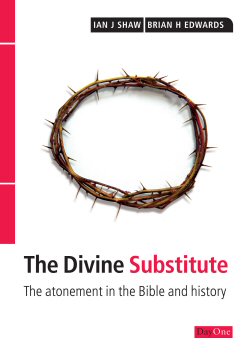 Colin and I recently picked up a copy of The Divine Substitute: The Atonement in the Bible & History, by Brian Edwards & Ian Shaw. As the doctrine of the atonement has been the subject of intense controversy, this book explores the belief that Christ died in the place of sinners, bearing their sin and guilt and the just and holy punishment that they deserved from God.
For those who seek to contend for biblical womanhood, a correct understanding of why Christ died must remain of utmost importance and central to all else. Here is an excerpt from the foreword to the book.
"John Wesley once claimed that nothing in Christian teaching 'is of greater importance than the doctrine of the atonement.' This book is based on the conviction that Wesley was right. It begins with a statement of the biblical doctrine of the atonement, followed by a survey of the broad Christian tradition from the early church to the present day. The deliberate focus is upon one specific aspect of the atonement: that of Christ's death as a divine substitute for sinners.This is a must read book, a vital contribution to recent controversies and one that contends for (what should be) the non-negotiable truth of substitutionary atonement.
In days when immediacy is everything, and when instant solutions are demanded, there is a great danger that in an effort to appear contemporary, Christians in the present generation will lose sight of the rich heritage of church teaching in this area. Rediscovering this tradition helps to counter views, both from within and outside the church, that would destabilise the faith of Christians and lead unsuspecting believers down routes that could prove spiritually harmful.
Viewing the issue of Christ bearing the punishment in the place of sinners, through the lens of Christian history, helps us to appreciate why the church has come to understand the teaching of the bible in a certain way, and why some approaches have been rejected in the past, and others retained. It raises fundamental questions about new developments - why has this not been adopted by the Christian church before? Many modern views of the atonement are a reworking of long rejected ideas, simply presented in contemporary packaging.
The richness of the way in which the Bible refers to the work of Christ upon the cross has been reflected in Christian writings throughout the history of the church. However, at the heart of Biblical teaching about the atonement is the substitutionary death of Jesus Christ, bearing the just penalty for sins. This profound truth draws together all the ways of speaking about the atonement; it is the operative principle that lies behind them. What this book shows is that this teaching on the penal and substitutionary death of Christ is not simply the product of one particular time or context. Although distinctive contributions have been made in certain eras, it is a glorious theme that has been taught at every period in the history of the church."
"This the power of the cross
Christ became sin for us
Took the blame, bore the wrath
We stand forgiven at the cross!" Getty & Townend
Saturday, October 14, 2006
Above All Earthly Powers
 Today's post, as you will see, is not exclusively for women but valuable for all believers. Recently, the 2006 Desiring God conference took place: Above All Earthly Powers featured a superb line up of speakers including D.A. Carson, Tim Keller, David Wells, Voddie Baucham, Mark Driscoll and John Piper.
The general theme is how we proclaim Christ in a postmodern world. Some highlights include a talk on 21st century evangelism by Tim Keller, and two panel discussions dealing with this same theme. Among the other talks, Carson (profound), Driscoll (amusing), and Piper (enthused) are well worth a listen. If you don't have time to listen to the talk in full, listen to some of the highlights of each talk, courtesy of Desiring God.
David Wells
"The Supremacy of Christ in a Postmodern World"
> Christ's Supremacy In The New Testament
> Christianity Is Becoming De-Westernized
> Fear In The West Is Not Of Being Unsafe, But Unsuccessful
> Risk In The West Is Not Of Danger, But Distraction
> Contextualisation And Foreign Missions
> Contextualisation And Preaching
> What Christianity Has To Offer
Voddie Baucham
"The Supremacy of Christ and Truth in a Postmodern World"
> Four Questions Everybody Asks
> Question #1: Who Am I?
> Question #2: Why Am I Here?
> Question #3: What Is Wrong With The World?
> Question #4: How Can What's Wrong Be Made Right?
> The Supremacy Of Christ In Education
> Argue For The Bible From The Bible
> The Risk In Racial Diversity
> Racism In Christian Cultures
Tim Keller
"The Supremacy of Christ and the Gospel in a Postmodern World"
> All Theology Has To Be An Exposition Of The Gospel
> If You Think You Understand The Gospel, You Don't
> The Gospel Must Be Urbanized To Reach The Culture
> Contextualisation makes The Gospel Plausible
> We Must Confront Unbelievers With Compassion
> Argue Against A False Worldview Using Its Presuppositions
Mark Driscoll
"The Supremacy of Christ and the Church in a Postmodern World"
> The Bible Is True For Everybody
> Without The Virgin Birth There Is No Jesus
> Christ's Death Saves Us From God
> Jesus Is The Only Way To God
> We Must Stress Both Christ's Humanity And His Divinity
> Everybody Believes In Hell
> Contextualising The Theology We Contend For
> John Calvin's Contextualisation
> Relativism vs. Relevantism
D.A. Carson
"The Supremacy of Christ and Love in a Postmodern World"
> Encouragment To Press On When You Feel Unsuccessful
> The Value Of Preachers Listening To Other Preachers
> How To Contextualise A Church Service
> Christian Unity Shows The World What God Is Like
> We Must Know Truth To Be Holy
John Piper
"The Supremacy of Christ and Joy in a Postmodern World"
> Encouragement For Pastors Of Small Churches
> Missions And Seeker-Sensitive Contextualisation
> The Personal Effect Of Writing What Jesus Demands From The World
> Affection For Emergents
> The Supremacy Of Christ And Joy In A Postmodern World: Short Version
> Why You Should Be Happy That You Are Less Valuable Than God
Speaker Panel
Various
A Conversation with the Pastors
Various
You can also watch video of the speaker interviews here
Subscribe to:
Posts (Atom)


